
Bengaluru
Bengaluru
Search Here
AUTHOR: Bewise-Admin

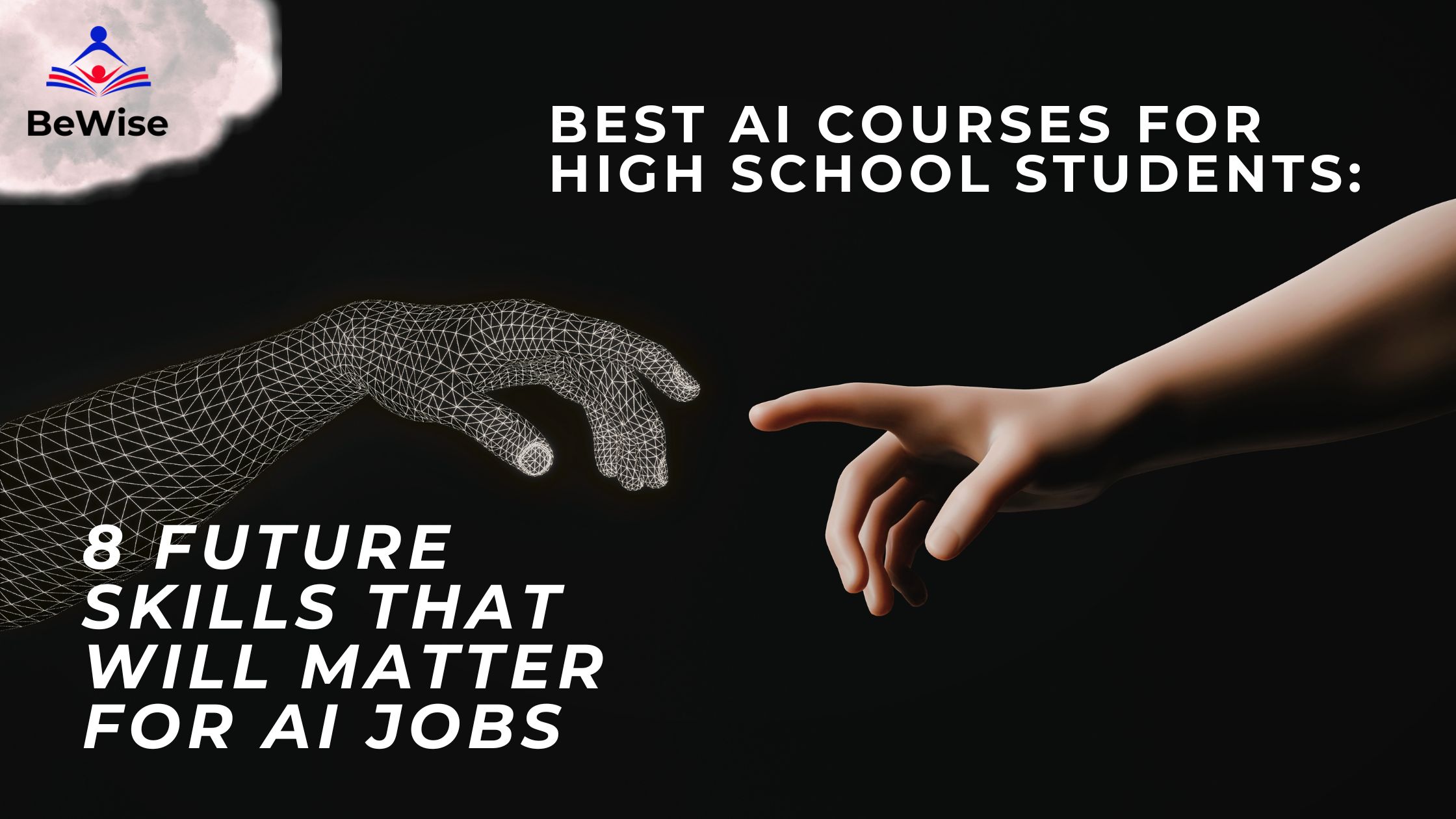
The idea that AI is "only for engineers" is fading fast and for good reason.
High school students are already living inside AI systems. Smart recommendations, personalized learning platforms, adaptive search - these aren't future technologies. They're part of how students learn and make decisions today. The real question isn't whether AI is relevant to them. It's whether they understand what's actually happening beneath the surface.
Because there's a meaningful difference between consuming AI and understanding it. Students who learn how it works early won't just adapt to what's coming. They'll be positioned to shape it.
That's why life skills education and early exposure to AI-based learning are becoming essential - not to turn every student into a coder, but to build the mindset and capability to work alongside intelligent systems confidently and critically.
Here are eight future-ready skills, and the kinds of AI courses for high school students worth exploring now.
Most students interact with AI every day without knowing what's happening behind it. That gap matters more than it might seem.
Introductory AI courses help students move from passive users to informed ones. They cover what AI is (and what it isn't), the basics of machine learning, how algorithms make decisions, and where these systems show up in the real world.
.jpg)
Removing the mystery early is valuable. Students who understand the mechanics are less likely to over-trust outputs — and more likely to ask better questions. This foundational awareness connects directly to broader educational and life skills that serve students across subjects, not just in technology.
AI runs on data. Students who understand data early gain a genuine and lasting advantage.
Data literacy for students means being able to read and interpret information, identify patterns and anomalies, question the accuracy and source of data, and use evidence to make decisions - rather than accepting numbers at face value.

According to the OECD Future of Education and Skills 2030 report, data literacy is among the core competencies students will need to navigate future careers and civic life. This isn't a skill that only matters in tech. It sharpens academic reasoning, improves logical thinking, and translates directly into everyday decision-making.
Not every student will become a programmer — and that's fine. But basic coding knowledge changes how students think, regardless of where they end up.
Beginner AI-related courses introduce things like basic Python programming, logical sequencing, problem decomposition, and simple automation projects. The goal isn't fluency. It's a shift in how students approach problems — breaking them into parts, testing assumptions, and thinking in systems.

This kind of computational thinking enhances analytical skills and changes how students engage with learning in any subject. Students who learn to code even briefly tend to ask sharper, more structured questions.
Here's what often gets missed in the conversation about AI and students: AI isn't replacing creativity. It's expanding what's possible with it.
Students today can use AI tools to generate stress-test ideas, create content, build simple designs, and experiment with storytelling in ways that weren't accessible before. Courses that combine creativity with AI teach something more important than any individual tool — they teach students how to collaborate with technology rather than compete against it.
.jpg)
This is also where entrepreneurship for students begins to take shape. When technology is used to support creative thinking, ideas move faster and iterate more effectively. That skill, combining imagination with execution, is increasingly central to how value gets created.
AI is powerful. That power comes with real consequences, and students need to understand them.
Courses covering AI ethics introduce students to bias in AI systems, data privacy, responsible use of technology, and academic integrity in an AI-assisted world. According to a UNESCO report on AI in education, awareness of ethical implications is one of the most critical gaps in student learning today - students are using these tools without the frameworks to evaluate them.
.jpg)
Teaching early matters for two reasons. It prevents misuse. And it builds the kind of independent, critical thinking that means students aren't just accepting AI outputs as truth - they're interrogating them.
The best AI learning programs for students are not primarily theoretical. They're built around doing it.
Project-based learning in AI might involve building simple models, working through real-life problem simulations, collaborating on group projects using AI tools, or competing in innovation challenges. This approach puts life skills education into practice rather than on paper.

When students connect what they're learning to actual problems, concepts stick differently. They stop memorizing and start applying. That transition, from passive understanding to active problem-solving, is one of the most important shifts educations can support.
AI is rarely built or used alone. The systems that matter are developed by teams, across disciplines, and deployed in contexts that require clear explanation to non-technical audiences.

Students need to practice working in groups, presenting ideas with clarity, explaining technical concepts to people who don't share their background, and collaborating on digital platforms. These aren't supplementary skills. They're central to employability programs for students and to long-term career success in any field that touches technology.
Even technically strong students hit a ceiling if they can't communicate what they know.
One of the most underrated benefits of early AI exposure is the clarity it creates.
When students engage with AI seriously even at a beginner level, they start to see the shape of what careers in this space look like. They discover that AI isn't a single path. It connects to healthcare, finance, education, design, law, policy, and more. They see roles that don't require deep coding knowledge alongside those that do.

This kind of early exposure directly supports career guidance after the 12th, helping students make informed choices grounded in real understanding - not just following trends or defaulting to conventional paths because they don't know the alternatives exist.
The most common mistake isn't ignoring AI entirely - it's going to be one of two unhelpful extremes. Either assuming it's too early to introduce these concepts or pushing advanced technical content on students who haven't built the foundational interest yet.
The reality is more straightforward. Students don't need pressure. They need exposure to ideas, tools, to people working in these fields. Parents searching for schools with life skills programs or meaningful technology integration are increasingly asking how schools introduce AI not just as a subject, but as a way of thinking.
That shift in how the question is framed matters a great deal.
The sheer volume of AI learning options available today can be overwhelming for both students and parents. Not all programs are equal, and not all are age-appropriate or genuinely useful.
Platforms like BeWise help by curating resources that are relevant and well-matched to a student's level, connecting AI learning with broader education and life skills development, and reducing the noise so families can make better decisions without spending hours evaluating every option.
The goal is not to overwhelm students with choices. It's to help them find the right starting point.
AI is no longer approaching. It's already shaping how students learn, how they'll work, and how they'll think through problems over the next several decades.
The students who succeed in that environment won't be those who've memorized the most. They'll be the ones who understand how intelligent systems work, think critically about their effects on society, use technology in genuinely creative ways, and keep evolving as the tools do.
That process doesn't begin in college. It begins now.
The question is no longer whether students should be learning AI. It's whether they're learning it in a way that actually prepares them.
1. What are the best AI courses for high school students to start with?
Beginner-friendly programs that cover machine learning fundamentals, data literacy, and basic coding — with hands-on projects built in — are the strongest starting point. Theory-only courses tend to lose students quickly; application-based learning sticks.
2. Do students need coding knowledge to learn AI?
Not at the outset. Many strong AI learning programs for students introduce concepts without requiring any programming background. That said, picking up basic coding gradually gives students a much clearer understanding of how AI systems actually function.
3. Why is data literacy important in AI learning?
Because AI systems are built on data, students who can't evaluate data critically will have difficulty evaluating AI outputs critically. Data literacy for students builds the ability to question, interpret, and draw conclusions from information — skills that matter well beyond any specific technology.
4. How do AI learning programs support career planning?
Exposing students to the full landscape of AI-adjacent careers is not just software development, but design, healthcare, finance, education, and more. This early awareness makes career guidance after 12th more grounded and intentional.
5. Can AI courses help develop life skills?
Yes — and the best ones do this deliberately. Critical thinking, collaboration, ethical reasoning, and creative problem-solving are embedded in well-designed AI courses for high school students, not treated as separate from technical content.

School
Pre School
Tuitions
After School Activity
Other Info
After School Activity
Community Support
Corporate Info
Contact Us


© Copyright 2026 BeWise & Wisdom Tech Solutions. All Rights Reserved. Bewise is a platform developed and managed by Wisdom Tech Solutions Pvt Ltd.